
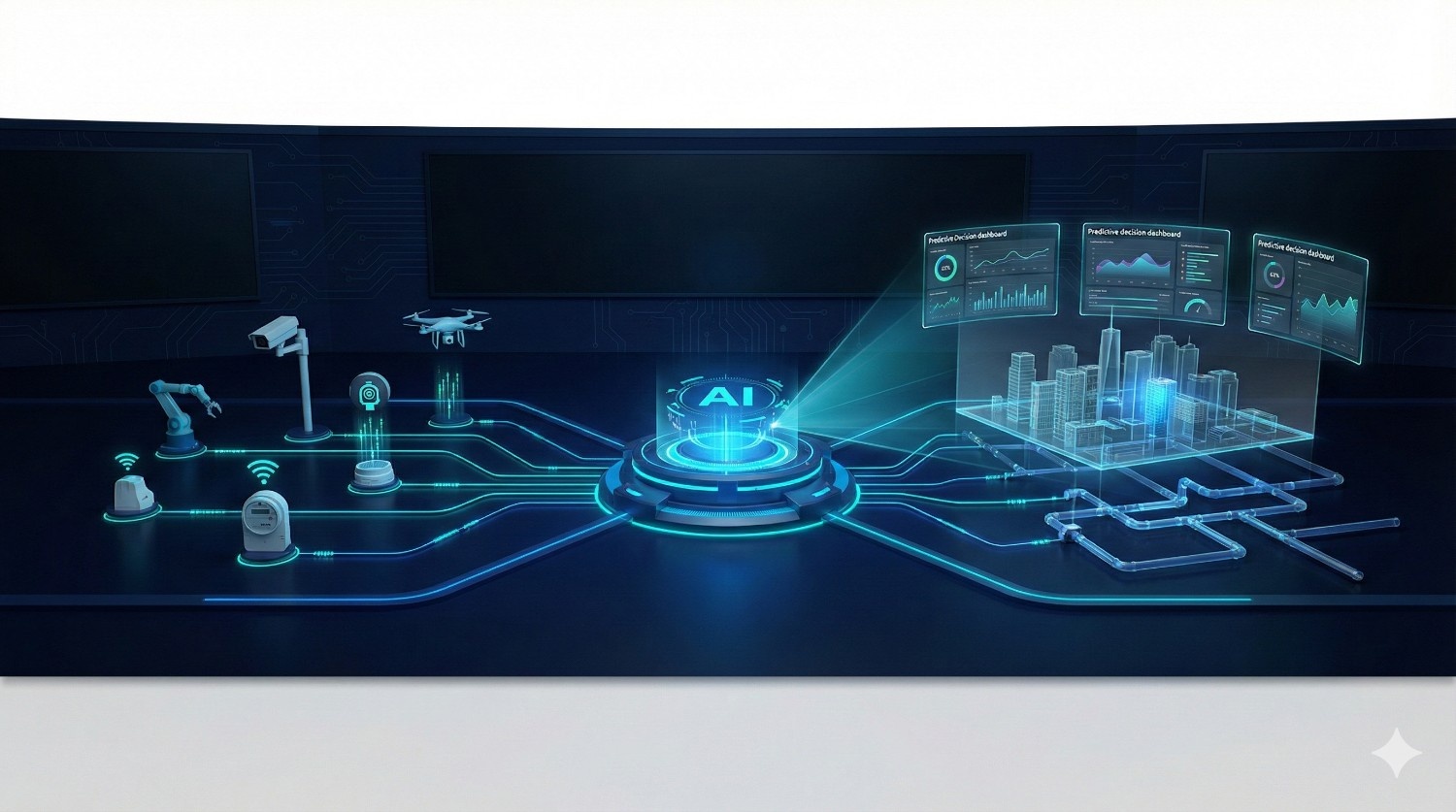
Digital Twin AI: What It Is, How It Works & Real-World Examples (2026 Guide)
Digital Twin AI is redefining how organizations understand, simulate, and optimize complex real-world systems. Instead of relying on static data or assumptions, businesses can now create intelligent virtual replicas that evolve in real time, learn from data, and predict outcomes before decisions are executed in the physical world.
From healthcare and manufacturing to smart cities, logistics, and AI avatars, AI-powered digital twins are quickly becoming a foundational layer of modern digital transformation. They bridge the gap between data, intelligence, and action—allowing teams to test scenarios, reduce risk, and improve performance at scale.
What Exactly Is a Digital Twin AI?
A Digital Twin AI is a virtual, intelligent replica of a physical object, system, process, or person that uses artificial intelligence and real-time data to simulate, predict, and optimize behavior across its lifecycle.
Traditional digital twins were largely descriptive—they mirrored the current state of an asset. Digital Twin AI goes much further by adding machine learning, predictive analytics, and adaptive intelligence. This means the twin doesn't just reflect reality; it understands it, learns from it, and anticipates what will happen next.
In practical terms, a Digital Twin AI can forecast failures, recommend optimizations, and continuously improve decision-making without human intervention. This shift—from visualization to intelligence—is what makes Digital Twin AI such a powerful concept.
How Does a Digital Twin AI Work?
A Digital Twin AI operates through multiple tightly connected layers that work together in real time.
1. Data Ingestion
The foundation of any Digital Twin AI is data. Continuous streams are collected from:
• Sensors and IoT devices
• APIs and software systems
• Operational databases and logs
This real-time data ensures the twin always reflects the current state of the physical or digital asset.
2. AI & ML Modeling
Machine learning models analyze incoming and historical data to detect patterns, correlations, and anomalies. Over time, these models learn normal behavior, identify early warning signals, and improve predictive accuracy.
This is where artificial intelligence transforms a digital twin from static to intelligent.
3. Simulation Engine
Once intelligence is applied, the twin can run thousands of "what-if" simulations. These simulations help answer critical questions such as:
• What happens if demand spikes?
• What if a component fails?
• How will performance change under different conditions?
4. Continuous Learning
As new data flows in, the Digital Twin AI updates itself automatically. This feedback loop allows the system to evolve, adapt, and stay accurate—even as real-world conditions change.
What Are the 4 Types of Digital Twins?
Digital twins are typically classified into four levels, depending on scope and complexity.
| Type | Description |
|---|---|
| Component Twin | Represents individual components such as sensors, valves, or engines |
| Asset Twin | Models an entire machine or physical asset |
| System Twin | Simulates how multiple assets interact within a system |
| Process Twin | Represents end-to-end workflows and operational processes |
Modern Digital Twin AI platforms often integrate all four types, enabling organizations to move seamlessly from component-level insights to system-wide optimization.
Digital Twin AI vs Simulation
While digital twins and simulations are often confused, they serve very different purposes.
| Digital Twin AI | Traditional Simulation |
|---|---|
| Uses real-time data | Uses static or historical data |
| Continuously learns | No learning capability |
| Predictive and adaptive | One-time or limited analysis |
| AI-driven decision support | Rule-based modeling |
Key insight: Simulation answers isolated questions. Digital Twin AI becomes a living system that evolves alongside reality.
Is Google Maps a Digital Twin?
Yes. Google Maps is a large-scale example of a digital twin applied to the real world.
It continuously mirrors real environments using:
• Live traffic and location data
• AI-powered route prediction
• Real-time environmental updates
This makes it a practical, everyday illustration of how digital twin principles work at global scale.
Can Humans Have a Digital Twin?
Yes. Human Digital Twins are an emerging application of Digital Twin AI.
They are used to simulate and analyze:
• Health metrics and disease progression
• Physical performance and fitness optimization
• Behavioral and cognitive patterns
• AI avatars and virtual assistants
In healthcare especially, human digital twins enable personalized treatment planning without putting patients at risk.
Digital Twin AI in Healthcare
In healthcare, Digital Twin AI is transforming how care is delivered and optimized. By modeling patients, organs, or hospital systems digitally, clinicians can test interventions virtually before applying them in real life.
Key applications include:
• Personalized treatment simulations
• Drug response modeling
• Predictive diagnostics
• Hospital workflow optimization
These capabilities reduce uncertainty, lower costs, and improve patient outcomes—making Digital Twin AI one of the most promising technologies in modern medicine.
Which Software Is Used for Digital Twins?
Several enterprise platforms power Digital Twin AI solutions today, combining cloud infrastructure, AI models, and real-time data pipelines.
Popular options include:
• AWS IoT TwinMaker
• Siemens Digital Industries
• Microsoft Azure Digital Twins
• NVIDIA Omniverse
These platforms provide the technical backbone for building, deploying, and scaling Digital Twin AI systems.
Why Do 85% of AI Projects Fail?
A large percentage of AI initiatives fail due to:
• Poor or inconsistent data
• Lack of real-world feedback loops
• Weak alignment with business processes
Digital Twin AI addresses these issues by grounding AI models in live systems, ensuring continuous validation and real-world relevance.
Key Benefits of Digital Twin AI
• Predict failures before they occur
• Optimize performance continuously
• Reduce operational and maintenance costs
• Enable safe experimentation without real-world risk
Frequently Asked Questions
Is a digital twin a robot? ›No. A digital twin is a software-based model, not a physical machine.
What are the three elements of a digital twin? ›A physical asset, a virtual model, and a real-time data connection.
What is a 4D digital twin? ›A digital twin that incorporates time-based evolution and predictive capabilities.
Copyright © 2026. All rights reserved.